How Do You Build a Menu That Actually Works for YOU?
Your first dopamine menu probably failed. Mine did too. Here's the step-by-step method that finally worked — audit, build, test, and rotate yours.
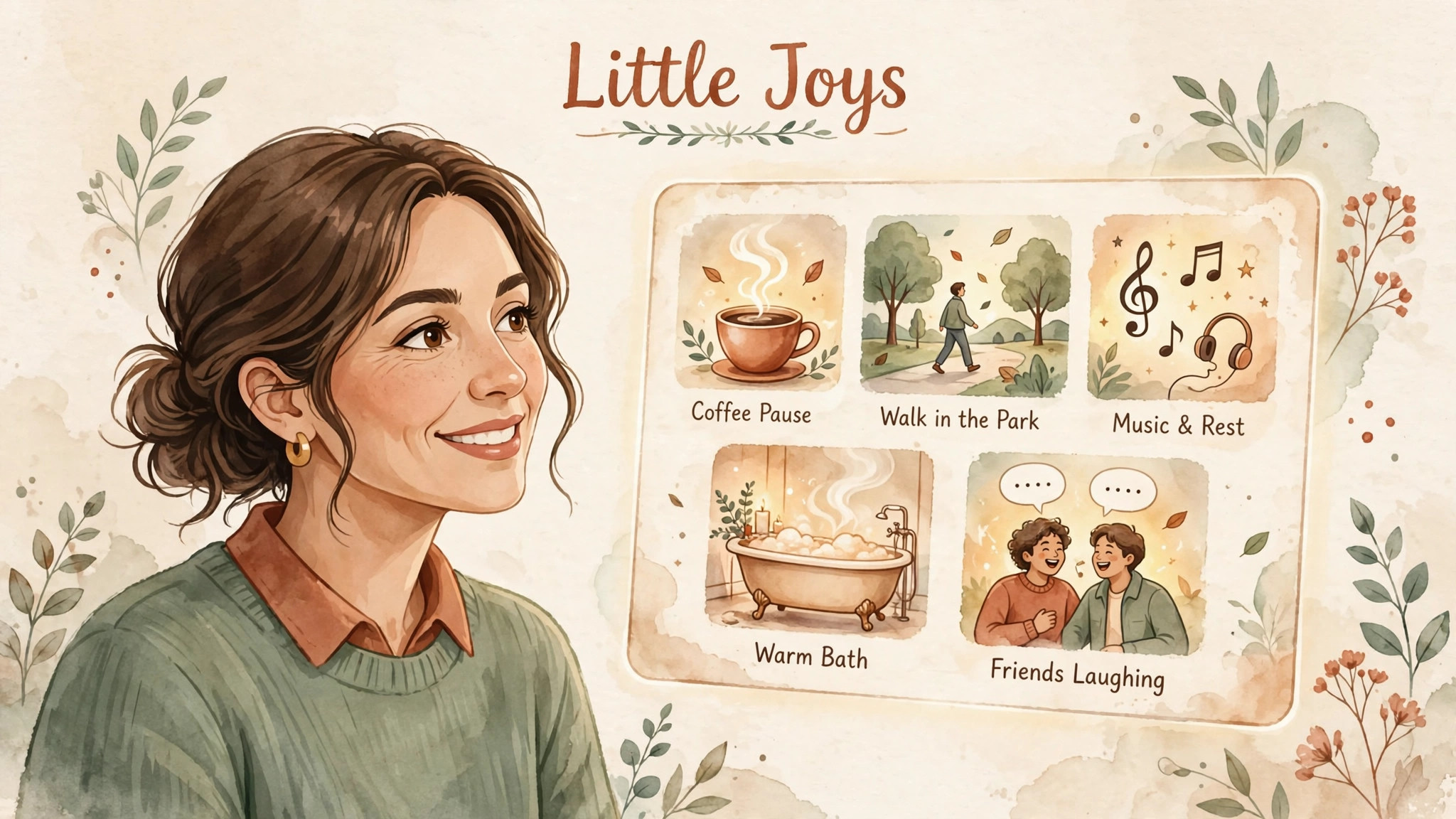
In the spring of last year, I spent an entire Sunday building my dopamine menu. I found a gorgeous template on Pinterest — watercolor borders, elegant serif font, little checkboxes. I printed it on the good paper. I filled it in with a fountain pen, which tells you how seriously I was taking this.
The menu said: Morning meditation. Green smoothie. Journaling. 30-minute walk.
By Wednesday, the beautiful menu was facedown on my desk, and I was eating dry cereal over the sink while refreshing the same three apps.
It took me months to understand why. The menu failed because it wasn't mine. It was a Pinterest stranger's idea of a good life, transcribed in fountain pen. Every item on it required motivation I didn't have, in service of a person I wasn't. "Morning meditation" is a fine activity. It has never once been my activity. I find meditation excruciating. Putting it on my menu was like prescribing myself a food I'm allergic to and then feeling guilty for not eating it.
So here's the guide I wish I'd had: how to make a dopamine menu that is actually yours — built from your real life and your real, specific, slightly embarrassing preferences. Not the life you think you should want. The one you actually have.
Step 1: The audit (3 days of honest tracking)
Before you build anything, you need data. For three days, keep what I call a dopamine diary. It's not fancy — it's a note on your phone with two columns.
Column A: what I did. Column B: how I felt after, on a scale of 1–3.
That's it. No judgment, no goals. You're a wildlife researcher observing a strange animal (you).
Here's what my first audit looked like, and I'm sharing the real numbers because the honesty matters:
- Scrolled Instagram, 45 min → felt like a 1 (hollow, buzzy)
- Walked to get coffee, 15 min → felt like a 3 (clear, calm)
- Watched 3 episodes of a show → felt like a 1 by episode 3 (numb)
- Called my sister, 20 min → felt like a 3 (warm, energized)
- Online shopping "research," 1 hour → felt like a 1 (anxious, wired)
- Cooked an actual dinner → felt like a 3 (proud, settled)
- Doomscrolled news, 30 min → felt like a 1 (dread-soaked)
- Sat on the balcony doing nothing, 10 min → felt like a 2 (bored but okay)
The pattern hit me like a truck: everything I reached for when I felt low scored a 1, and everything I resisted as too much effort scored a 3. My instincts were perfectly, precisely backwards.
Your audit will show your own pattern. There are no wrong answers in the audit. There's only information.
Do the full three days. One day lies to you. Three days tells the truth.
Step 2: Sort into "feeds me" vs "drains me"
Take everything from your audit and sort it into two lists. Be brutally honest.
Feeds me (scored 2–3, left me the same or better): the coffee walk, the sister call, cooking, the balcony nothing-time.
Drains me (scored 1, left me worse): the 45-minute scroll, the third episode, the shopping "research," the news spiral.
Now — and this is the uncomfortable part — look at how you actually spend your low moments. I spent mine almost entirely in the "drains me" column. Seeing it written down, in my own handwriting, was what finally made it real.
The "feeds me" list is the raw material for your menu. Not a guru's list. Not Pinterest's list. Yours, proven by your own data.
Step 3: Learn the 3-tier framework
A dopamine menu borrows its structure from a restaurant menu, and the structure matters more than you'd think. When you're depleted, choosing from an unstructured list of twenty activities is paralyzing. Choosing from three small categories is manageable.
Appetizers: 5 minutes or less — for when you're running on fumes. Nearly effortless things, doable from the couch if necessary. Mains: 20–45 minutes — for when you have some energy to invest. A walk, cooking, calling a friend. Desserts: wind-down only — gentle evening items. The tea ritual, fiction in bed, tomorrow's top three on paper. Desserts are the tier everyone forgets and the tier ADHD brains need most.
The rule of the framework: match the tier to your energy, not your ambition. A depleted brain choosing a "main" will fail and feel worse. A restless brain choosing only "appetizers" will stay unsatisfied. Check in with your actual energy level — not the level you wish you had — and order accordingly.
Step 4: Draft your menu (the specificity rule)
Now write your first draft. And here's the rule that changed everything for me:
Every item must be specific enough that a stranger could do it.
"Walk" is not a menu item. "Walk to the corner bakery and back" is a menu item. "Relax" is not a menu item. "Sit on the balcony with tea for ten minutes" is a menu item. Vague items die in the gap between intention and action; specific items survive because there's nothing to decide.
My first working draft of my dopamine menu looked like this:
Appetizers: 60-second sky stare (barefoot if possible) · cold water on wrists · one song full volume, no phone in hand · text Mom one sentence · make the bed
Mains: walk to the bakery and back, no fitness tracker · cook one real thing with actual seasoning · call Priya while folding laundry · 20-minute timer nap · one drawer, organized
Desserts: chamomile in the blue mug, same chair · one chapter of the comfort novel · tomorrow's top three on the notepad · 10 minutes of slow stretching on the bedroom floor
Twelve items. All mine. Every one proven by my audit or by honest trial. It fit on an index card. I stuck it on the fridge with a magnet shaped like a taco.
Step 5: The 2-week test
A menu isn't finished when you write it. It's finished when it's been tested. For two weeks, use the menu — and keep scoring, 1 to 3, just like the audit.
Here's what you'll learn: some items will underperform. The bakery walk might be a 3 on Sundays and a 1 on rainy weekdays. This is normal. You're not looking for perfection; you're looking for a batting average.
My rule: any item that scores 1 three times in a row gets voted off. No guilt. The menu serves you, not the other way around. In my first test, I lost four of twelve items — including, painfully, the 20-minute nap, which I loved in theory and abused in practice.
And promote your surprises. The sky stare was a throwaway addition to my draft. It became my most-used item within a week.
Step 6: Rotate (the 6-week refresh)
Brains adapt. The song that lifted you in March does nothing by May. This isn't ingratitude — it's neurology. Dopamine responds to novelty, so a static menu slowly goes stale.
Every six weeks or so, do a quick review. I do mine on the first Sunday of every other month, with coffee, and it takes ten minutes:
- Cross out anything that's gone flat (no ceremony, no guilt)
- Promote anything new you've discovered since last time
- Check the balance: do you still have items in all three tiers?
- Forgive the aspirational items you haven't done. Either make one specific and doable, or let it go.
My current menu shares maybe four items with that first working draft. That's not failure — that's a menu that's alive.
Your text-form checklist
Cut this out (metaphorically — or literally, it's your life). Here's the whole method on one card:
```
MY DOPAMINE MENU — BUILD CHECKLIST
□ 3-day audit done (activity + 1-3 score, no judgment)
□ Sorted into "feeds me" vs "drains me"
□ Drafted 9-12 items across 3 tiers
□ Every item specific enough for a stranger to do
□ Appetizers doable from the couch
□ Desserts are gentle (evenings only)
□ 2-week test with scoring
□ Underperformers voted off (3 strikes)
□ 6-week refresh scheduled
□ It's on the fridge, not in a drawer
```
That last one is only half a joke. The laminated Pinterest menu lived in a drawer. The taco-magnet index card lives on the fridge. Guess which one I use.
The mistakes I made (so you don't have to)
Copying someone else's menu. The fountain-pen disaster. Your brain is not their brain. Audit first, always.
All aspiration, no reality. If every item requires you to be the best version of yourself, the menu will only ever serve the best version of yourself — who doesn't need it.
Skipping desserts. I did this for months. My evenings were a scrolling wasteland while my beautiful menu covered only daytime. The dessert tier fixed my nights.
Too many items. My second draft had twenty-seven items. It was a Cheesecake Factory menu — impressive, paralyzing. Twelve is my sweet spot. Yours might be nine or fifteen, but it's not thirty.
Never revisiting. A menu you write once and never update becomes a museum exhibit. The six-week refresh is the difference between a tool and a relic.
What changed
It's been over a year since the fountain-pen menu failed. My current index card is creased and has a coffee ring on it, which feels about right.
I still crash. I still scroll too long some nights. The menu didn't fix my brain — nothing does that. What it did was shrink the distance between "I feel awful" and "I did one small thing that helped." That distance used to be a canyon. Now it's a step.
Build yours this week. Not the pretty version — the honest one. Audit for three days, draft twelve specific items, stick it on the fridge. Your future flat Tuesday-night self will thank you. Mine does, regularly.
This is how I learned to make a dopamine menu that actually works for me — personal experience from living with ADHD, not medical advice. Your brain, your data, your menu.
Want the full system?
My book The Late-Diagnosed Woman's ADHD Guide has 20 chapters of practical systems, 14 worksheets, and a 30-day reset plan — written by someone who lives this.
Get the book on Amazon Download Chapter 1 freeFAQs
How is "my dopamine menu" different from a regular self-care list?
The structure and the personalization. A self-care list is usually an unstructured pile of generic suggestions ("take a bath!") with no guidance on when to use what. My dopamine menu is tiered by energy level, built from my own audited data, specificity-tested, and rotated every six weeks. The tiers are the real difference — when I'm depleted, I don't have to evaluate twenty options. I look at five appetizers and pick the smallest one. That energy-matching is what makes it usable in the moments I actually need it.
What if I do the audit and everything scores a 1?
Then the audit is telling you something important, and it's not that you're broken. When I was in a genuinely bad stretch two years ago, almost everything scored a 1 — and that turned out to be depression sitting on top of my ADHD, flattening everything. If nothing feeds you, even things that used to, that's worth bringing to a doctor. But also check: are you scoring honestly, or scoring how you think you should feel? The balcony nothing-time felt like a 2 to me and I almost didn't write it down because it seemed too small to count. Small counts.
Can I share a dopamine menu with my partner or family?
You can share the method, but don't expect to share the menu. My husband and I both have menus and they overlap on maybe two items. His appetizers include "ten push-ups," which for me would be a punishment, not a pleasure. What works beautifully is building them side by side — same three days of auditing, comparing notes, stealing the framework but not the contents. It's actually a lovely couples activity, if your idea of romance includes spreadsheets of feelings.
How long until my dopamine menu starts working?
The audit takes three days, the draft takes an hour, and you'll get some benefit immediately just from having options visible. But the menu really hits its stride after the two-week test, when the underperformers are gone and what's left is proven. For me, the honest answer is about three weeks from blank page to a menu I trusted. It's not instant — but nothing that rewires a habit is. Give it the three weeks. Future-you is counting on it.

Rachel Morgan was diagnosed with ADHD at 34, after decades of wondering why everything felt harder for her. She writes practical, shame-free systems for women whose brains work differently — from the book The Late-Diagnosed Woman's ADHD Guide.
This site shares personal experiences and general information, not medical advice. Please consult a qualified professional for diagnosis or treatment.