What If You Were Never Lazy — Just Undiagnosed?
Millions of women discover their ADHD at 30, 40, 50. The grief is real. The relief is bigger. Here's what late diagnosis really feels like.
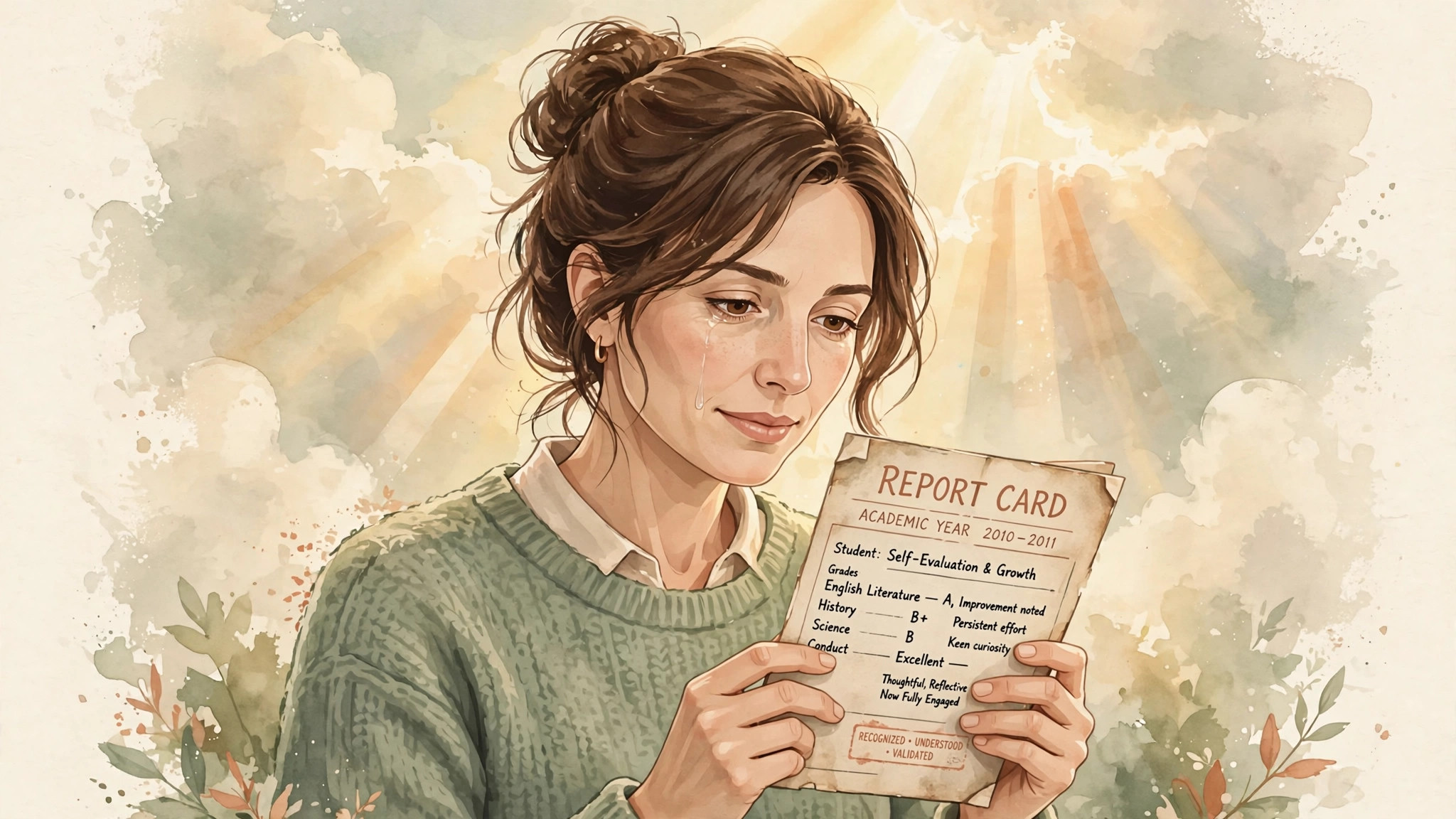
I was 34 years old, sitting in my car in a parking lot, crying so hard I couldn't see the steering wheel.
I'd just come from the appointment. The one where the psychiatrist looked at my questionnaire, looked at me, and said: "You have ADHD. Combined type. And based on your history, you've had it since childhood."
Thirty-four years. Three decades of report cards saying "so much potential." Of planners bought in January and abandoned by March. Of friendships strained because I forgot to call back — again. Of sitting in rooms full of people who seemed to be operating on instructions I'd never received.
And the whole time, there was a reason. A neurological, documented, treatable reason. Nobody noticed. Including me.
I cried in that parking lot for twenty minutes. And here's the strange part — I wasn't just sad. I was relieved. I was angry. I was grieving. I was hopeful. All at once, like someone had shaken every emotion I owned into a snow globe.
If you're reading this because you suspect — or just learned — that you might have ADHD as an adult woman, I want you to know: whatever you're feeling right now is normal. All of it. Even the contradictory parts.
Why nobody noticed (and why it's not your fault)
This is the question that haunted me for months: how did everyone miss this?
Teachers. Parents. Doctors. Me. How?
The answer made me angry at first, then sad, then — eventually — free. Because the reason nobody noticed isn't that my ADHD was subtle. It's that the entire system was looking for the wrong thing.
ADHD research was built on boys. For decades, the studies, the diagnostic criteria, the checklists — all based on hyperactive young boys. The kid bouncing off the walls, disrupting class, can't sit still. That's the picture everyone had in their head.
But ADHD in girls and women often looks completely different. Not hyperactive — inattentive. Not disruptive — daydreamy. Not bouncing off walls — quietly drowning while appearing to function.
I wasn't the kid causing trouble. I was the kid staring out the window, lost in elaborate imaginary worlds, who still managed decent grades because I was smart enough to compensate. Nobody flags the quiet girl. The quiet girl is "fine."
We learn to mask. This is the big one. Girls are socialized — relentlessly — to be agreeable, organized, helpful, put-together. So we build masks. Elaborate, exhausting, invisible masks.
My mask was perfectionism. I over-prepared for everything. I made lists of lists. I rehearsed conversations in my head before having them. I stayed up until 2 AM finishing projects I'd been unable to start for three weeks, then showed up looking polished like it was effortless.
From the outside: competent, together, fine.
From the inside: running on fumes, held together by anxiety and caffeine, one bad day away from collapse.
Masking works — until it doesn't. Usually it breaks in adulthood, when life gets complex enough that no amount of over-preparation can cover the gaps. A demanding job. Kids. A household to run. Perimenopause scrambling whatever coping systems you had left. That's when many women finally hit the wall and start asking questions.
Our symptoms get mislabeled. Anxiety. Depression. "Just stress." Hormones. Being "too sensitive." Before my ADHD diagnosis, I'd been told I had anxiety (I did — secondary to undiagnosed ADHD, as it turns out). I'd been told I was probably depressed. One doctor suggested I just needed better work-life balance, which is the medical equivalent of "have you tried being less busy?"
Women's ADHD symptoms — the overwhelm, the emotional intensity, the exhaustion — get filed under mood instead of neurology. Because the diagnostic lens was calibrated for boys, and we're looking through it at women.
The grief no one warns you about
Here's what nobody tells you about late diagnosis: the relief comes first, and then the grief arrives like a delayed package you didn't order.
Grief for the years. I keep doing the math and I wish I'd stop. What if I'd known at 14 instead of 34? Would college have been different? Would I have chosen a different career — one that fit my brain instead of fighting it? Would I have been kinder to myself for twenty years instead of... this?
Grief for the relationships. The friendships I let fade because I couldn't manage the maintenance. The partner who thought I didn't care because I forgot the things that mattered to him. I can't get those back. I can only do better going forward, and some days that doesn't feel like enough.
Anger at the system. I'm not going to pretend I'm over this one. Girls are still being missed right now. The criteria are better than they were, but not good enough. Every time I hear about a woman diagnosed at 40, 50, 60, I feel furious on her behalf — and then I remember to feel glad she found out at all.
And underneath it all: relief. Bone-deep, exhale-for-the-first-time-in-decades relief. Because the story I'd told myself for 34 years — that I was lazy, broken, not trying hard enough — was wrong. It was never true. My brain works differently. That's all. That's everything.
If you're in the grief stage right now, let me tell you what I wish someone had told me: the grief is proof you're processing, not proof something's wrong. Feel it. Don't rush past it to "but at least now I know!" Toxic positivity helps no one. You lost years. You're allowed to mourn them.
What changes after diagnosis (and what doesn't)
A diagnosis isn't a magic wand. I want to be honest about that, because the internet sometimes sells it like one.
What changed for me:
I stopped moralizing my symptoms. Forgetting something isn't a character flaw anymore — it's an executive function glitch, and I need a system for it. This single shift in framing changed my inner monologue from cruel to... neutral. Sometimes even kind. I'm still working on kind.
I got language for my experience. "Time blindness." "Rejection sensitive dysphoria." "Executive dysfunction." These aren't just labels — they're explanations. And explanations are the opposite of shame. Shame thrives in vagueness ("what's wrong with me?"). It withers in specificity ("oh, that's impaired working memory").
I built systems instead of relying on willpower. The whole second half of my book is this — practical, ADHD-brain-designed systems for time, home, work, and daily life. Not because I'm fixed, but because I finally understood what I was working with.
I found my people. Online communities of late-diagnosed women — reading their stories felt like finding a room full of people speaking my native language for the first time. If you haven't found yours yet, look. We're everywhere.
What didn't change:
I still have ADHD. A diagnosis explains it; it doesn't erase it. I still lose my keys. I still underestimate how long things take. I still have days where my brain feels like a browser with 47 tabs open.
The difference is that now I know why, and I have tools, and — most importantly — I've stopped hating myself for it. That last one took the longest. It's still a practice, not a destination.
If you think this might be you
I can't diagnose you. I'm not qualified, and a blog post isn't a clinical assessment. But I can tell you what I tell every woman who writes to me asking "do you think I have it?":
If you read about ADHD in women and felt like someone had been secretly observing your life — that's worth exploring. Not with an internet quiz (though we've all taken them at 1 AM), but with a professional who actually understands how ADHD presents in adult women. Specifically ask about their experience with adult female ADHD. Not all clinicians are equally informed — this matters enormously.
Bring examples. Specific ones. "I lose my keys three times a week" is more useful than "I'm disorganized." "I've bought eleven planners and never used one past February" tells a story. The patterns across your life — childhood through now — are what clinicians look for.
And whatever the outcome — diagnosis or not — the systems in this site and my book work for any brain that struggles with executive function. You don't need a label to deserve tools that work.
The beginning, not the ending
I'm 34 — well, older now — and I'm still learning what it means to live in this brain on purpose instead of by accident. Some days are hard. Some days I still grieve.
But I also have something I didn't have for the first 34 years: an accurate map. I spent decades navigating with the wrong one, wondering why I kept getting lost. Now I know the terrain. Now I can build routes that actually work.
If you're standing where I stood in that parking lot — scared, relieved, angry, hopeful, all at once — welcome. You're not late. You're right on time. The fact that you're here, reading this, asking these questions? That's the beginning of everything.
→ Get The Late-Diagnosed Woman's ADHD Guide on Amazon
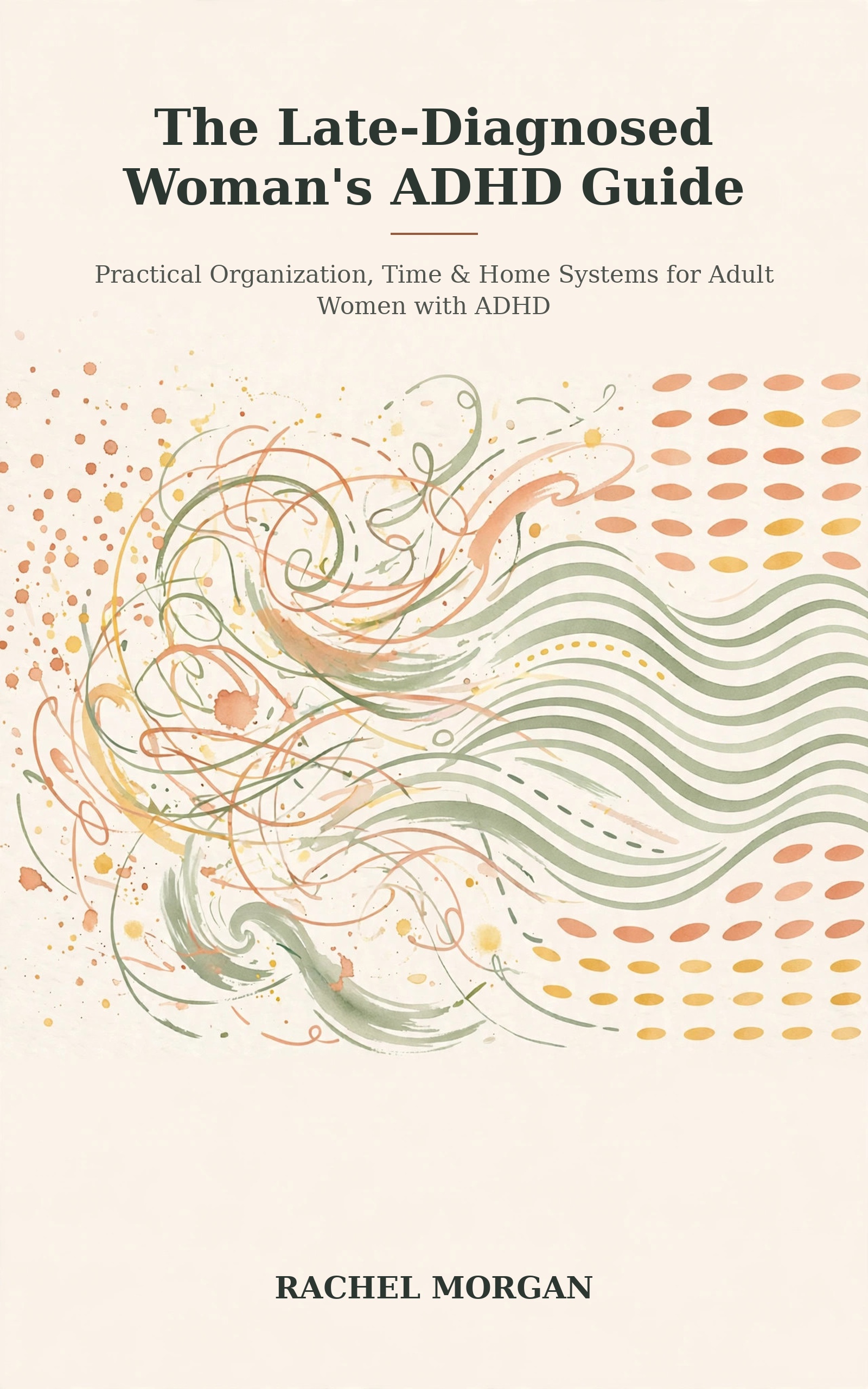
Want the full system?
My book The Late-Diagnosed Woman's ADHD Guide has 20 chapters of practical systems, 14 worksheets, and a 30-day reset plan — written by someone who lives this.
Get the book on Amazon Download Chapter 1 freeFAQs
Is it common for women to be diagnosed with ADHD as adults?
Yes — increasingly so. Research shows women are significantly underdiagnosed in childhood because diagnostic criteria were historically based on hyperactive presentations more common in boys. Many women are diagnosed in their 30s, 40s, or later, often after their coping strategies stop working under adult demands.
Can ADHD develop in adulthood, or was it always there?
ADHD is neurodevelopmental — it's present from childhood, though it may not have been recognized. What looks like "adult-onset" ADHD in women is almost always ADHD that was masked, mislabeled, or compensated for during childhood. A qualified assessment looks for evidence of lifelong patterns.
Will a diagnosis actually change anything?
For many women, yes — profoundly. Beyond access to treatment options, diagnosis provides an accurate framework for understanding lifelong struggles, which alone can dramatically reduce shame. It also opens the door to ADHD-specific strategies rather than generic productivity advice that was never designed for your brain.
What if my doctor doesn't believe me?
This happens, unfortunately. Seek a second opinion from a clinician with specific experience in adult ADHD — particularly in women. Organizations like CHADD maintain directories. You deserve an assessment from someone who understands how ADHD actually presents in adult women, not just the textbook hyperactive profile. ---
Rachel Morgan was diagnosed with ADHD at 34, after decades of wondering why everything felt harder for her. She writes practical, shame-free systems for women whose brains work differently — from the book The Late-Diagnosed Woman's ADHD Guide.
This site shares personal experiences and general information, not medical advice. Please consult a qualified professional for diagnosis or treatment.