ADHD in Adult Women: The Complete Guide
The complete guide to ADHD in adult women — symptoms doctors miss, late diagnosis, and real systems for time, home, and work. Start here.

If you're here, there's a decent chance you've spent a significant portion of your life feeling like everyone else received an instruction manual you somehow missed.
The planners that die by February. The chronic lateness that isn't about respect. The bedroom chair that's technically furniture but functionally a closet. The exhaustion of holding it all together while feeling like you're barely holding on.
I'm Rachel. I was diagnosed with ADHD at 34. Before that day, I had a different explanation for all of it: I was lazy. Undisciplined. A mess. Not trying hard enough.
I was wrong about all of it. And if any of this sounds familiar, you might be wrong about yourself too.
This guide is everything I wish someone had handed me years ago — what ADHD actually looks like in adult women, why it's missed so often, and the practical systems that finally made my life work. Not theory. Not clinical coldness. The real stuff, from someone living it.
What ADHD in women actually looks like
Forget everything you think you know about ADHD. The popular image — hyperactive little boy, bouncing off walls, can't sit still — describes one presentation, in one age group, of one gender. It's like describing "birds" using only penguins.
In adult women, ADHD more commonly looks like this:
The inattentive picture. Not hyperactive — elsewhere. Losing the thread mid-conversation. Reading the same paragraph four times. Starting tasks and abandoning them. A brain with forty tabs open, all playing different audio. From the outside, you might look calm. Inside, it's static.
Chronic overwhelm disguised as competence. Many of us are good at appearing functional. We over-prepare. We make lists. We say yes to everything and then work until 2 AM to deliver. People think we're thriving. We're drowning — just quietly, and with excellent time management theater.
Emotional intensity. Big reactions to small things. Rejection feeling like physical pain. Crying at commercials and then feeling ridiculous about it. The emotional regulation differences in ADHD are real and profound, and in women they're often mislabeled as "being too sensitive" or misdiagnosed as mood disorders.
The exhaustion. Not regular tired — the specific exhaustion of spending all day manually doing what other people's brains do automatically. Holding the plan in your head. Forcing yourself to start. Masking the struggle. By evening, there's nothing left. And then you feel guilty for being tired, which is its own special hell.
Time that doesn't behave. Hours vanishing. Deadlines that weren't real until they were emergencies. "Five more minutes" as a lifestyle. (There's a whole article on this — time blindness — because it deserves one.)
The shame. I put this last because it's the heaviest, and because it's the one nobody talks about. Decades of internalized failure. The belief that you're just less — less disciplined, less adult, less together than everyone else. This isn't a symptom in the diagnostic manual. But ask any late-diagnosed woman, and she'll tell you it's the most painful part.
Why it gets missed (the short version)
The full story is in my article on late diagnosis, but here's the condensed version:
ADHD research was built on hyperactive boys. The diagnostic criteria, the checklists, the clinical picture — all calibrated to a presentation that's less common in girls and women. We present more often as inattentive, internalized, and masked. We compensate. We people-please. We develop anxiety that looks like the primary problem when it's actually secondary to undiagnosed ADHD.
So we get misdiagnosed (anxiety, depression, "stress"), or missed entirely, often for decades. The average age of diagnosis for women is significantly later than for men. Many of us don't find out until our 30s, 40s, or beyond — usually when life gets complex enough that our coping systems collapse under the weight.
If this is making you angry on behalf of your younger self — good. That anger is information. It means you're starting to see clearly.
The systems that actually work
Here's what I learned the hard way: generic productivity advice doesn't work for ADHD brains. "Just use a planner." "Just try harder." "Just be more organized." The word "just" in those sentences is doing tremendous heavy lifting.
What works instead: systems designed for how our brains actually function. Not the brains we wish we had — the ones we do have. Here are the foundations:
Make the invisible visible
ADHD brains lose track of anything that isn't directly in front of them. Out of sight is literally out of mind. So the master principle: externalize everything.
- Visual timers you can watch (not just hear) for time blindness
- Open storage, clear bins, labels on everything for home organization
- The launch pad by the door for mornings
- Sticky notes, whiteboards, anything physical and in-your-face
If your brain can't hold it internally, put it in the world. That's not cheating. That's engineering.
Shrink everything until starting is easy
"Clean the apartment" will paralyze you. "Tidy the coffee table for 10 minutes" might not. The task isn't the problem — the size of the task is.
- Time-boxing: every task gets a container with edges (20 minutes, not "until done")
- The minimum viable version: what's the smallest version that still counts? Do that.
- Night-before prep: tomorrow's decisions get made tonight, when your brain works better (morning routine)
Starting is the hardest part of everything. So make starting ridiculously easy. The bar should feel almost insulting. That's how you know it's right.
Borrow other people's nervous systems
Body doubling — working in the presence of another person — is one of the most effective ADHD strategies that exists. It sounds too simple. It works anyway.
Coffee shops. Libraries. Video coworking. A friend on the couch. The presence of another person provides just enough external structure to get your brain into gear. Use it shamelessly and often.
Build routines around your real brain
Not the 5 AM miracle routine. Not the color-coded planner system that requires more executive function than the tasks it's supposed to organize. Routines built for your brain:
- Anchored to things you already do (prep while dinner heats up)
- Forgiving on bad days (the minimum viable version)
- Focused on reducing decisions, not adding structure for its own sake
The morning routine guide walks through this in detail.
The emotional work (don't skip this)
I could give you every system in the world, and it wouldn't be enough without this part. Because the biggest obstacle isn't disorganization or lateness. It's the story you've been telling yourself for decades.
I'm lazy. I'm a mess. Everyone else can do this. What's wrong with me?
That story is wrong. It was always wrong. But knowing it's wrong intellectually and feeling it's wrong are different things, and the feeling takes longer.
Here's what helped me:
Name it to tame it. When the shame spiral starts, I literally say (out loud, if I'm alone): "That's the old story. The old story is wrong. What's actually happening is [executive dysfunction / time blindness / decision fatigue]." Specificity kills shame. Vagueness feeds it.
Collect evidence for the new story. Every time a system works — every on-time arrival, every found key, every completed task — it's a data point. Your brain has decades of data for the old story. You need to deliberately build the case for the new one. I kept a "wins" note on my phone for the first year. It felt silly. It worked.
Find your people. Online communities of ADHD women. A therapist who gets it. A friend who nods instead of judging when you explain. You spent years feeling alone in this. You don't have to anymore.
Grieve if you need to. Late diagnosis brings grief — for the years, the relationships, the kinder life you might have had. That's in the late diagnosis article, and I mean it: don't rush past it. The grief is part of the healing, not an obstacle to it.
Where to go from here
This site is organized around the areas where ADHD hits hardest. Start wherever hurts most:
- Where Did the Last 3 Hours Go? — Understanding time blindness and the visual systems that fix it
- Why Do Your Mornings Feel Like a War Zone? — The night-before prep and minimum viable morning
- What If You Were Never Lazy — Just Undiagnosed? — The grief, relief, and reality of late diagnosis
- Why Can You Focus With Someone There (But Not Alone)? — The simplest, strangest focus tool that works
- Is Your Mess a Brain Problem, Not a Character Flaw? — ADHD-friendly organizing (no Marie Kondo required)
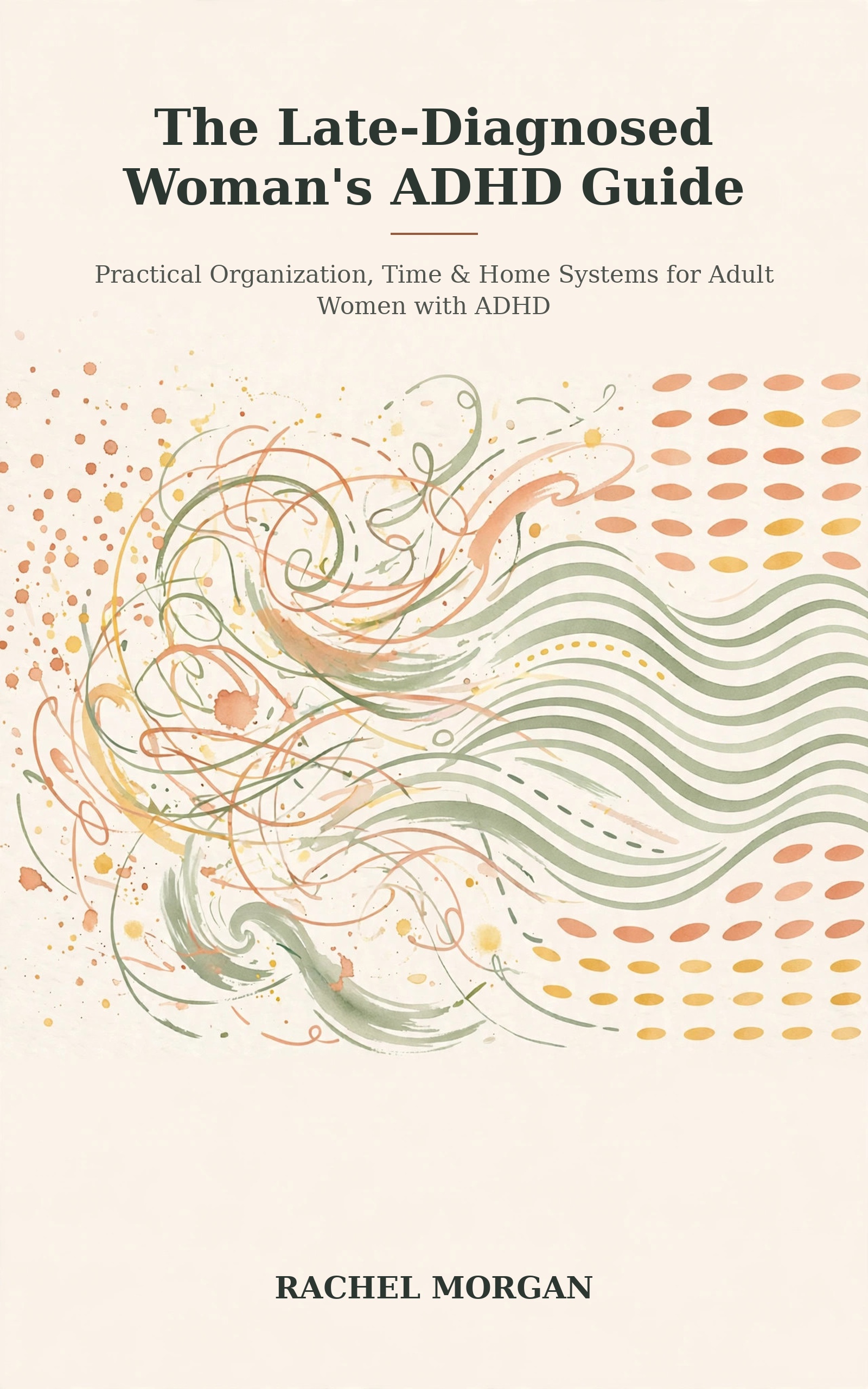
And if you want it all in one place — the complete systems, fourteen worksheets, the 30-day reset plan, the conversation scripts — that's the book:
→ Get The Late-Diagnosed Woman's ADHD Guide on Amazon
New here and not sure? Read the first chapter free. No email, no catch:
A final word
I spent 34 years thinking I was broken. If I'd had this guide at 24, or 19, or 14 — if anyone had told that quiet, daydreamy girl that her brain just worked differently — so much pain could have been avoided.
I can't go back. But I can make sure the next woman finds this sooner. Maybe that's you. Maybe you're 34, or 44, or 54, sitting in your own version of that parking lot, wondering if it's too late.
It's not too late. You're not broken. You never were.
Welcome. Let's build a life that works for your brain — starting now.
Want the full system?
My book The Late-Diagnosed Woman's ADHD Guide has 20 chapters of practical systems, 14 worksheets, and a 30-day reset plan — written by someone who lives this.
Get the book on Amazon Download Chapter 1 freeFAQs
What are the main symptoms of ADHD in adult women?
The most common presentation is inattentive: chronic disorganization, difficulty sustaining focus, forgetfulness, time blindness, and trouble completing tasks. Emotional dysregulation, overwhelm, and exhaustion from masking are also typical. Unlike the hyperactive stereotype, many women appear calm externally while struggling intensely internally.
How is ADHD diagnosed in adult women?
Diagnosis involves a comprehensive evaluation by a qualified professional — clinical interview, history across the lifespan, and standardized rating scales. It's important to find a clinician experienced with adult ADHD presentation in women specifically, as general practitioners may be less familiar with how it differs from the textbook profile.
Can you develop ADHD as an adult?
ADHD is neurodevelopmental, meaning it's present from childhood. What appears as "adult-onset" is typically ADHD that was masked, compensated for, or misdiagnosed earlier in life. Adult demands — careers, households, parenting — often exceed the capacity of childhood coping strategies, making symptoms visible for the first time.
What's the first step if I think I have ADHD?
Start by learning — which is what you're doing right now. Then, if it resonates, seek an assessment from a professional experienced with adult ADHD in women. Bring specific examples from across your life. And regardless of diagnosis, you can start building ADHD-friendly systems immediately — you don't need a label to deserve tools that work. --- This guide shares personal experience and general information only — not medical advice, diagnosis, or treatment. Please consult a qualified healthcare professional for guidance about your situation.

Rachel Morgan was diagnosed with ADHD at 34, after decades of wondering why everything felt harder for her. She writes practical, shame-free systems for women whose brains work differently — from the book The Late-Diagnosed Woman's ADHD Guide.
This site shares personal experiences and general information, not medical advice. Please consult a qualified professional for diagnosis or treatment.