What Is a Dopamine Menu (And Why Does Your Brain Need One)?
Your brain runs on dopamine — and an ADHD brain leaks it like a bucket with holes. This menu trick made my 3pm crash survivable. Here's how it works.
It was a Tuesday, 3:47 in the afternoon, and I was standing in my kitchen staring into the fridge like it owed me money.
I wasn't hungry. I wasn't thirsty. I just couldn't figure out what to do next. My laptop sat open on the table with seventeen tabs. The laundry was half-folded on the couch, exactly where I'd abandoned it two hours earlier. My phone had three unanswered texts glowing at me. And there I stood — bare feet on the cold tile, fridge door hanging open, cold air on my face — waiting for my brain to hand me a single instruction.
Nothing came.
If you have ADHD, especially the kind that got diagnosed three decades late like mine was, you know this exact feeling. It's not tiredness. It's more like the power went out in one specific room of your head. The room where "doing things" lives. Everything else works fine — I could've told you the capital of every country I'd ever visited — but the part that decides what next had simply left the building.
That evening, my friend Priya sent me a voice note. Seven minutes long. Priya does not believe in short voice notes. Somewhere around minute four, half-laughing, she said, "Babe, you need a dopamine menu."
I had no idea what that meant. But the name alone was weird enough to make me listen to the rest.
The leaky bucket in your head
Here's the part I wish someone had explained to me at twenty instead of thirty-four.
Dopamine is the chemical your brain uses for motivation. Not happiness — motivation. It's the quiet little signal that makes a task feel worth starting. In most brains, dopamine hangs around long enough to carry you from "I should do this" to actually doing it.
In ADHD brains, it drains fast. Picture a bucket with holes in the bottom. Everyone's bucket leaks a little — that's just being human. Ours leaks like it's got a grudge. By mid-afternoon, the bucket's empty, and that's when you're standing in front of the fridge with no instructions and no idea how you got there.
I'd spent years trying to fix this with willpower. Planners. Apps. A whiteboard system so elaborate it needed its own maintenance schedule. None of it worked, because all of it assumed the bucket was full. None of it accounted for 3:47 PM.
A dopamine menu is exactly what it sounds like: a literal menu. A list of small things that refill your bucket, written down ahead of time — on a decent day, when your brain is cooperating — so that on an empty-bucket day, you don't have to think. You just order off the menu.
No decisions. No seventeen tabs. Just: pick one.
Appetizers, mains, and desserts
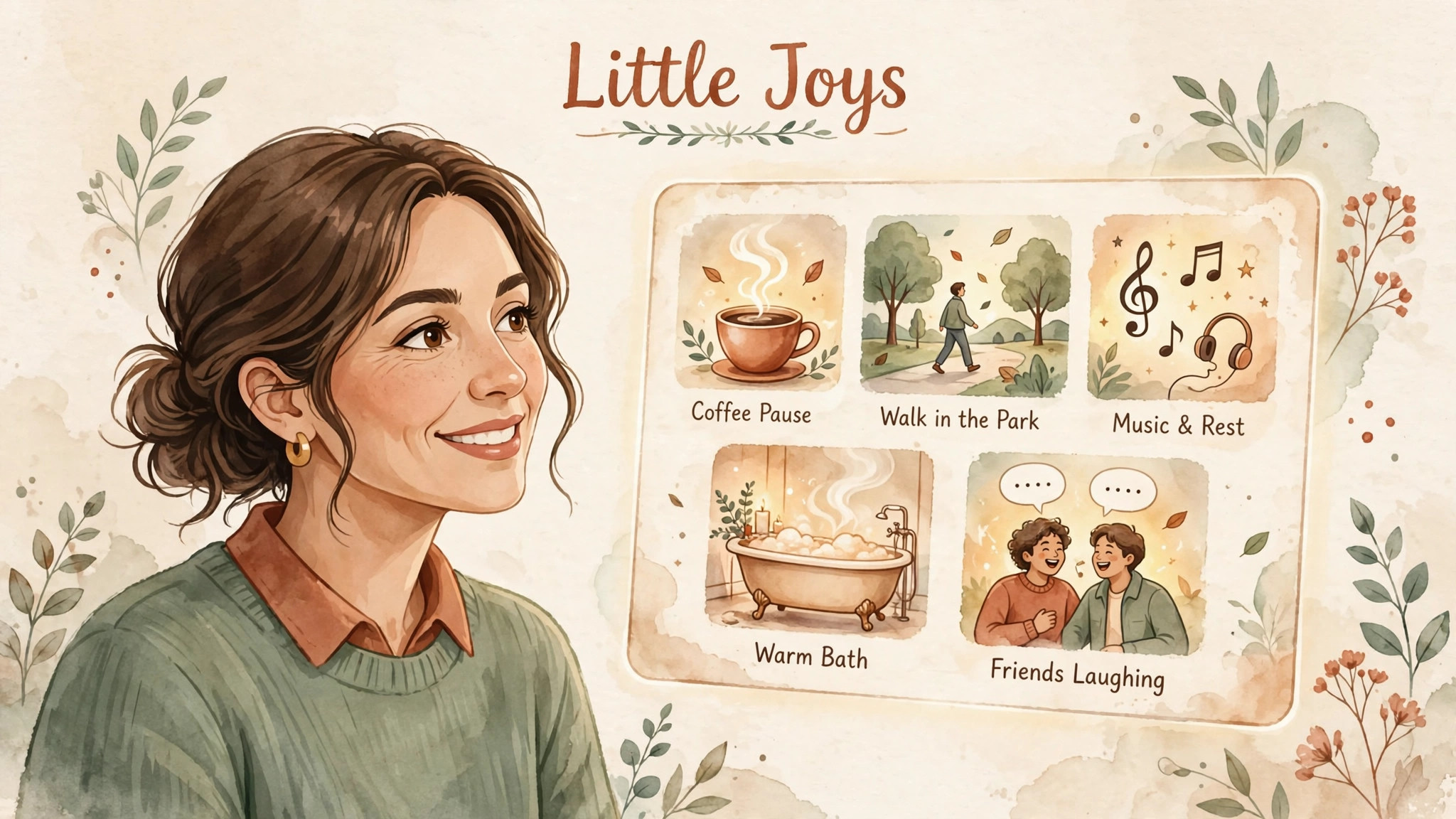
The version that stuck for me breaks the menu into three courses, and I love it because it finally gave me permission to count small things as real things.
Appetizers are five-minute boosts. Tiny. Almost embarrassingly small. That's the point — when the bucket is empty, you cannot order a feast. You need a breadstick.
Mine include: one song, danced badly, in the kitchen. Not exercised — danced. There is a difference and my downstairs neighbor can confirm it. Standing outside for three minutes doing absolutely nothing, which felt lazy until I realized it was medicine. Cold water on my wrists and the back of my neck. Texting one friend something funny, just to hear my phone buzz back. And making the bed, which I resisted for years on principle ("it's just going to get unmade!") until I admitted that the principle was costing me a free dopamine hit every morning.
Mains are thirty-minute resets. These are for when you have a little more in the tank, or when an appetizer worked and you're ready for course two.
Mine: a walk with no destination and a podcast I actually like — not an educational one, not self-improvement, just people being funny in my ears. Cooking something that smells good, because smell goes straight past all the broken wiring. Cleaning one drawer. Not the room. Not the closet. One drawer. I have strong feelings about the drawer rule. Calling my sister, who always makes me laugh within ninety seconds — I timed it once.
Desserts are wind-down treats. The things that tell your nervous system the day is allowed to end.
Mine: tea in the good mug, phone in another room. Ten pages of a novel — not a self-help book, a novel, with plot and everything. And my personal favorite, the one I guarded like a secret for years: sitting in my parked car for eight minutes before going inside. Not scrolling. Just sitting. Letting the day drain off me before I walk through the door and become a person who answers questions about dinner.
Yours will look completely different, and that's the whole idea.
How to actually build yours
I built my first menu wrong, so let me save you the trip.
First, brain-dump on a decent day. Not your best day — you'll write things like "run a marathon" — and not your worst day, when nothing sounds good. A regular Tuesday. Sit down and list every small thing that has ever given you even a flicker of lift. Be shameless. "Smell the rain" counts. "Organize my spice jars alphabetically" counts if it genuinely does it for you. Nobody sees this list but you.
Second, sort by time, not by virtue. This was my mistake. My first menu was sorted by what I should do — exercise, meditate, journal — and I never touched it, because "should" is just shame wearing a trench coat. Sort by how long things take: under five minutes, around half an hour, evening wind-down. The menu works because it's easy, not because it's impressive.
Third, put it where you'll actually see it. Mine is taped inside the kitchen cabinet, right at eye level where the mugs are. A friend of mine made hers her phone lock screen. Another keeps his on an index card in his wallet, which I love — very analog, very him. If it's in a notes app you'll never open, it doesn't exist.
Fourth — and this is the big one — order before you're empty. I spent months using my menu only at 4 PM, when I was already face-down in the fridge. It helped, but barely. Then one day I ordered an appetizer at 2 PM, while I still had some dopamine left, and the whole afternoon went differently. The menu isn't an emergency room. It's maintenance. You don't wait for the car to die on the highway; you get the oil changed.
Fifth: no optimizing. This is a rule and I am strict about it. The menu is not a productivity system. It's a life raft. You do not decorate a life raft. You do not A/B test a life raft. If dancing badly to one song works, you dance badly to one song and you do not spend three weeks researching whether a different song would work 4% better. Ask me how I know.
What actually changed
I want to be honest with you, because the internet is full of people promising that one trick fixed their entire life, and I am not one of those people.
The dopamine menu did not fix my life. I still lose my keys. I still have weeks where the bucket has more holes than bucket. Last month I forgot a dentist appointment that I had made, which feels like it should be impossible.
But the afternoons changed. They stopped being a cliff I fell off every single day at 3:47 PM. They became a dip I could see coming — and I had a rope ladder I'd built myself on a better day, taped inside a kitchen cabinet.
There's a specific kind of grief in realizing you've spent thirty years blaming your character for what was actually chemistry. And there's a specific kind of relief in finding out the bucket can be refilled on purpose, in five-minute increments, with things as small as cold water and one good song.
Start with the appetizers. The mains can wait.
I'm not a doctor, and this is not medical advice — it's just the thing that finally worked for my very stubborn brain. If you're struggling, a professional who understands ADHD is worth their weight in gold.
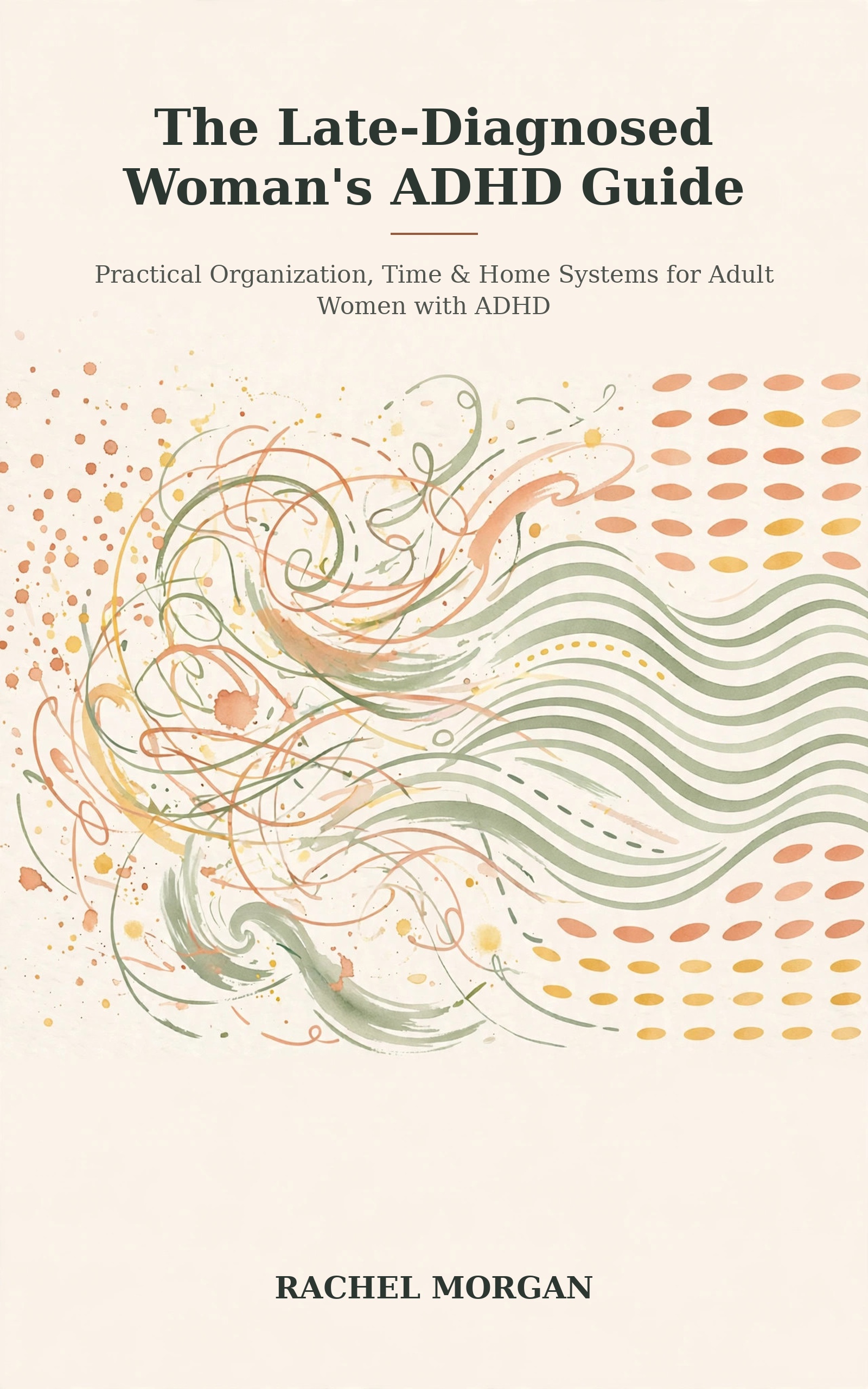
Want the full system?
My book The Late-Diagnosed Woman's ADHD Guide has 20 chapters of practical systems, 14 worksheets, and a 30-day reset plan — written by someone who lives this.
Get the book on Amazon Download Chapter 1 freeFAQs
Is a dopamine menu actually backed by science?
The phrase "dopamine menu" itself is a popular framework, not a clinical term you'll find in textbooks. But it's built on real ideas — behavioral activation, reward scheduling, and what researchers know about dopamine and motivation in ADHD brains. Think of it as folk wisdom wearing a lab coat: the packaging is new, the principles underneath are solid.
What if nothing on my list sounds good when I'm already low?
That's exactly why you write the list ahead of time — your low-brain can't be trusted to brainstorm, but it can follow instructions. When everything sounds terrible, give yourself permission to pick the smallest, dumbest appetizer on the list. Cold water on your wrists. Three minutes outside. The bar is on the floor on purpose.
How is this different from a to-do list?
A to-do list asks things of you. A dopamine menu gives things to you. One drains the bucket, the other fills it. I keep mine completely separate — my to-do list lives in an app I resent, and my menu lives in my kitchen cabinet where I actually like it.
Can I use a dopamine menu if I'm on ADHD medication?
Lots of people do both, and they work well together — medication helps the bucket hold water, the menu helps refill it. But I'm not your doctor, and dosing and treatment are personal. If you're on medication or thinking about it, that's a conversation for you and your prescriber, not a blog post.
Rachel Morgan was diagnosed with ADHD at 34, after decades of wondering why everything felt harder for her. She writes practical, shame-free systems for women whose brains work differently — from the book The Late-Diagnosed Woman's ADHD Guide.
This site shares personal experiences and general information, not medical advice. Please consult a qualified professional for diagnosis or treatment.