50 Tiny Joys That Actually Fix Your Flat, Foggy Days?
50 concrete dopamine menu ideas that actually work — 5-minute appetizers, 30-minute mains, and wind-down desserts, tested by a woman with ADHD.
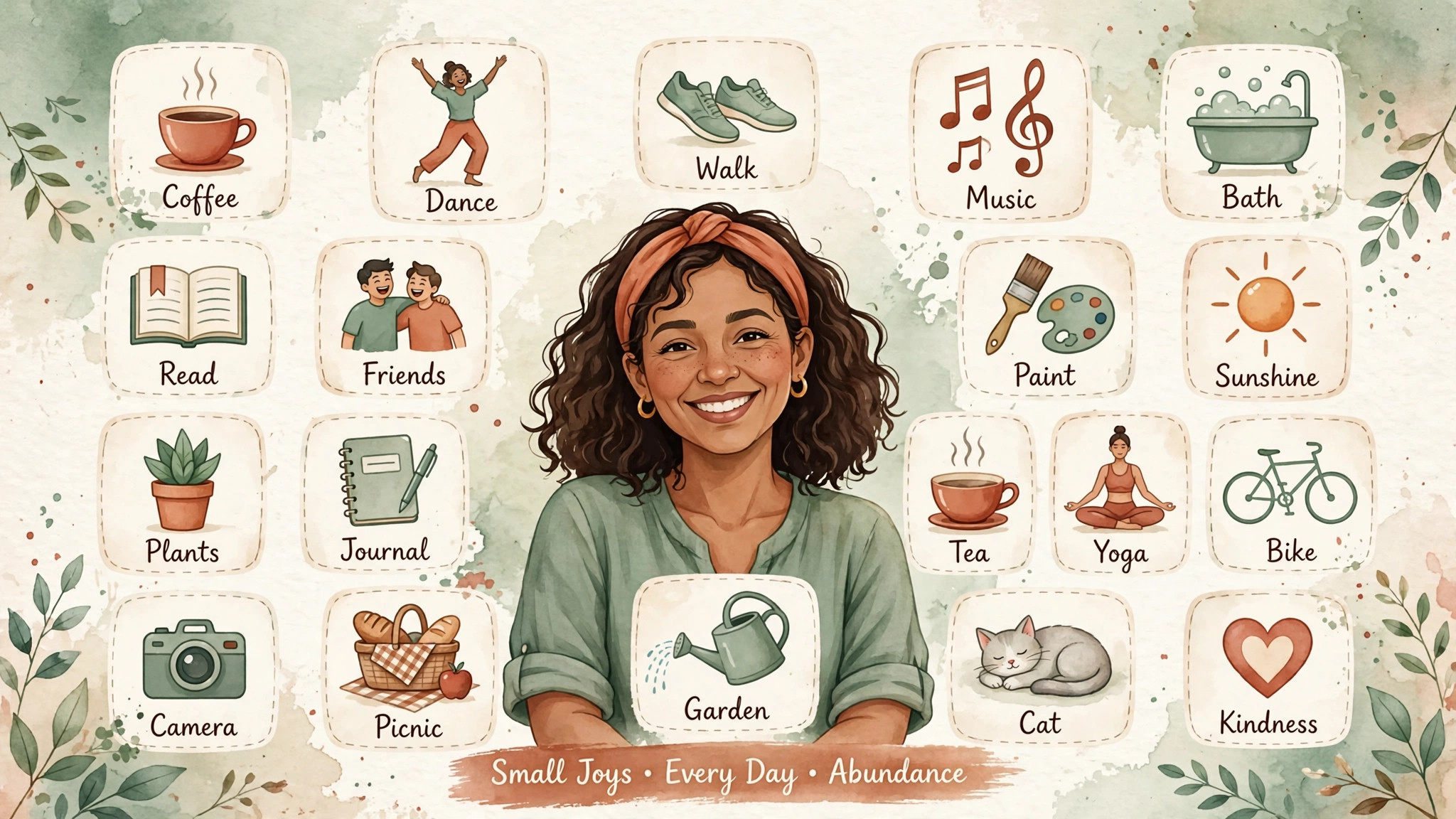
I have a junk drawer in my kitchen. Not the normal kind with batteries and rubber bands — though it has those too. This drawer contains eleven printed self-care lists, four gratitude journals (two untouched), and a laminated card titled MY DAILY JOY MENU that I made during a particularly enthusiastic Sunday and never looked at again.
The laminated card is my favorite artifact of failure. It says things like "meditate" and "journal" and "nourishing walk in nature." You know what I did on the Monday after laminating it? Scrolled Instagram for two hours and ate cereal over the sink.
Here's what I've learned since then: the problem wasn't me. The problem was that every list I'd ever found was written by someone whose brain works normally, full of activities that require the exact motivation I was trying to generate.
So I built my own list. Tested each item, kept what worked, crossed out what didn't. These are my dopamine menu ideas: fifty of them, organized like a restaurant menu, because your depleted brain deserves options, not lectures.
How to actually use this list
Don't try to do all fifty. That's the laminated-card trap. Instead: read through once and star anything that makes you think "oh, that sounds nice." Pick 3–5 per tier, write them where you'll see them, and when you're flat, choose from your short list — never the whole universe.
The tiers work like a real menu: appetizers (5 minutes or less — for when you can barely move), mains (20–45 minutes — for when you have some gas in the tank), and desserts (wind-down items — for evenings, when stimulation needs to be gentle).
🥗 Appetizers — 5 minutes or less
For the moments when getting off the couch feels like a negotiation with a hostile government. Each of these dopamine menu ideas takes almost no time and almost no decision-making.
- 1. Step outside and look at the sky for 60 seconds. Not a walk. Just stand there. I do this barefoot when I can — something about it resets me faster. ★ Personal favorite
- 2. Cold water on your wrists. Thirty seconds under the tap. Sounds fake. Works anyway.
- 3. One song, full volume, no multitasking. My current pick is an embarrassingly upbeat pop song from 2014 that I will not be naming here.
- 4. Smell something good. Coffee beans, an orange peel, a candle, your partner's shampoo. Scent hits the brain fast.
- 5. Stretch like a cat. Arms overhead, big yawn, the whole dramatic performance. Your body doesn't know you're faking it.
- 6. Text one person something kind. Not a conversation — a single sentence. "Thinking of you" counts. Connection is potent stuff.
- 7. Make your bed. Sixty seconds, one finished thing, instant visual order. ★
- 8. Drink a full glass of water. Dehydration masquerades as exhaustion with alarming skill.
- 9. Write down three things you can see. A grounding trick my therapist taught me. "Blue mug. Dust in the sunlight. My terrible handwriting." It yanks you into the present.
- 10. Dance to one chorus. Not the whole song — the chorus. Kitchen dance parties are a legitimate medical intervention as far as I'm concerned.
- 11. Step into the sun. Even through a window. Light is medicine for a flat brain.
- 12. Chew mint gum. The sensory jolt is small but real, and it keeps your mouth busy instead of your phone.
- 13. Splash through a memory. Open your camera roll to "one year ago today." Nostalgia is a gentle dopamine source.
- 14. Tidy one surface. Not the room — one surface. The nightstand. One shelf. Contained victory.
- 15. Hold ice. A cube in each hand for thirty seconds. Strong sensory input that snaps you out of fog. (My psychiatrist suggested this one. I thought she'd lost it. She had not.)
- 16. Name five things you're looking forward to. They can be tiny. "Lunch. The new episode. Bed." Anticipation is dopamine.
- 17. Compliment yourself out loud. Feels ridiculous. Do it anyway. "I got up today. That counts."
- 18. Change your clothes. Even into different pajamas. It signals a state change to your brain.
- 19. Put on a scent you love. Perfume, lotion, an essential oil on your wrists. Scent bypasses logic and goes straight to mood.
- 20. Ten jumping jacks. Right where you stand. A tiny burst of movement that tells your nervous system you're alive.
🍲 Mains — 20 to 45 minutes
For when you have a little energy and want to spend it well. These dopamine menu ideas take more investment and pay more back.
- 21. Cook one real thing. Not a production — scrambled eggs with actual seasoning, toast with toppings arranged like you care. The chopping, the sizzling, the eating: it's a full sensory sequence. ★
- 22. A walk with no destination. Leave the fitness tracker at home. Wander. Look at gardens, dogs, interesting doors. The "no destination" part is load-bearing — it removes performance pressure.
- 23. Call someone you like. Not text — voice. Ten minutes. I call my college roommate while folding laundry and always hang up feeling more human.
- 24. Work on something with your hands. Knead dough, repot a plant, fix the wobbly drawer, build the flat-pack shelf. Tangible progress is brain candy.
- 25. Take a real shower. Not the functional rinse — the long one. Hot water, good soap, maybe a podcast. Showers are where my best thinking happens.
- 26. Do a puzzle or a crossword. One section, not the whole thing. Structured, completable, satisfying.
- 27. Write a messy journal page. Not gratitude lists — messy. Complain. Rant. Doodle in the margins. Getting it out of your head and onto paper lightens something.
- 28. Gardening, even one pot. Digging in soil has actual studied mood effects, and watching something grow because of you is quietly profound.
- 29. Learn one small thing. A magic trick. Three chords. How to say "I'm tired" in Japanese. Novelty feeds the ADHD brain like nothing else. ★
- 30. Exercise, but make it fun. Dance video, swimming, a bike ride to get ice cream. If it feels like punishment, it won't stick — I learned this after eleven abandoned gym memberships.
- 31. Organize one drawer. The junk drawer, ironically, was deeply satisfying to conquer. Contained chaos → order is a visible win.
- 32. Bake something and give half away. The baking is the activity; the giving is the multiplier. My neighbors now expect banana bread every few weeks.
- 33. Go somewhere new nearby. A street you've never walked, a café you've passed a hundred times. Newness is a drug for our brains — use it intentionally.
- 34. Photo walk. Take your phone (this time on purpose) and photograph ten interesting things. It turns a walk into a treasure hunt.
- 35. Nap with a timer. Twenty minutes, alarm set, no guilt. A real nap is restorative; a three-hour accidental nap is a trap. The timer is everything.
- 36. Play a game with someone. Cards, a board game, even a silly phone game together. Social + playful is a double hit.
- 37. Rearrange one shelf. Not the whole room — one shelf, one corner. Newness in your environment feeds the novelty-hungry brain.
- 38. Write a real letter. Paper, pen, stamp. To anyone. The slowness of it is the point.
🍰 Desserts — wind-down items
Evenings need gentleness. These are for when the day is done and your brain needs to land softly, not launch again. The dessert tier of dopamine menu ideas is the one most lists forget, and it's the one I needed most.
- 39. Herbal tea ritual. Same mug, same spot, every night. The ritual itself becomes the signal: day over, rest beginning. ★
- 40. Read fiction in bed. Not self-improvement — fiction. A story that carries you. I've read the same comfort novel four times and I'm not ashamed.
- 41. Gentle stretching or yoga. The slow kind. Ten minutes on the floor while something calming plays.
- 42. A warm bath or foot soak. Add the fancy salt. Light the candle. You're worth the twelve minutes of preparation.
- 43. Write tomorrow's top three. Three things, on paper, by the bed. It empties the mental loop that keeps ADHD brains awake.
- 44. Listen to a calm playlist. No lyrics, or lyrics in a language you don't speak. Let it wash over.
- 45. Draw or doodle. Badly is fine. Mandalas, patterns, your own hand traced over and over. Repetitive hand motion is soothing in a way I can't explain.
- 46. Watch one comfort episode. One. The show you've seen six times, where nothing surprising happens. Familiarity is restful; novelty at 10 PM is a trap.
- 47. Gratitude, but specific. Not "family" — "the way the light hit the kitchen table this morning." Specificity makes it real.
- 48. Cuddle something warm. Partner, pet, heated blanket, a hot water bottle shaped like an animal. Warmth is primitive comfort.
- 49. Plan something to look forward to. A weekend trip, a dinner reservation, even a library hold. Ending the day with anticipation in the tank changes the morning.
- 50. Tidy the bedroom. Five minutes. Waking up to order instead of chaos is a gift to future-you.
My actual top 10 (the ones I really do)
Honesty time. Of these 46 ideas, here are the ten I actually reach for weekly — the rest are situational:
- 1. The 60-second sky stare ★
- 2. One song, full volume
- 3. Making the bed
- 4. Cooking one real thing
- 5. The walk with no destination
- 6. Calling my roommate while folding laundry
- 7. The herbal tea ritual
- 8. Writing tomorrow's top three
- 9. Kitchen dance party (one chorus)
- 10. Texting one person something kind
And the ones I wish I did but mostly don't? Gardening (my plants fear me) and the 20-minute nap (I always "forget" to set the timer). I keep them on the list anyway — aspiration isn't failure, it's a direction.
Build yours this week
Here's my challenge: pick five from this list today. Write them on a sticky note and put it where you'll see it at your lowest point. Then, when the gray fog rolls in, don't ask "what should I do?" — look at the note and pick the smallest one. That's the whole method.
Your brain doesn't need a laminated card and a 30-day challenge. It needs options it can actually reach. Start with five.
These dopamine menu ideas come from my own trial and error living with ADHD — personal experience, not medical advice. What lifts one brain might not lift another, and that's exactly why building your own list matters.
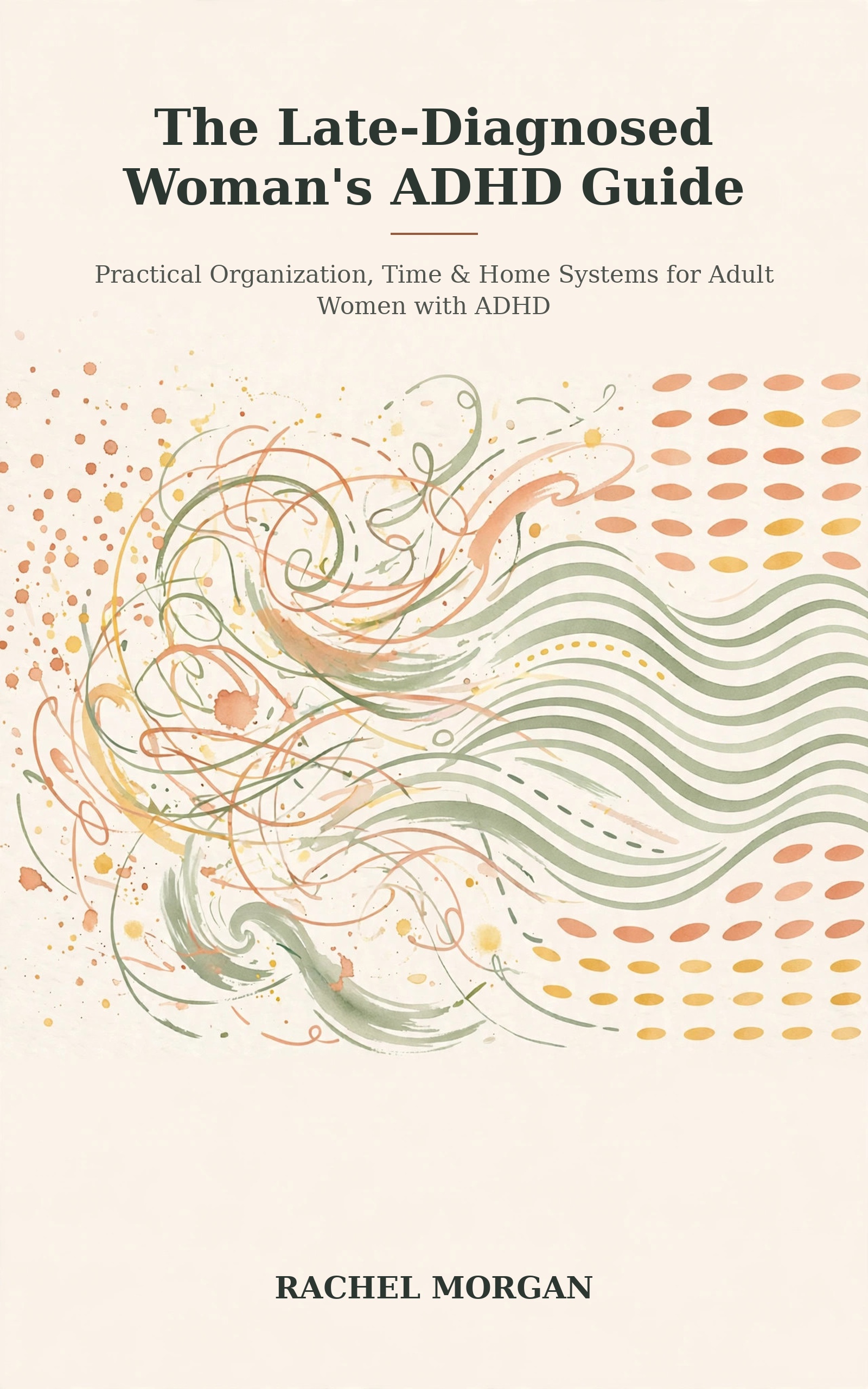
Want the full system?
My book The Late-Diagnosed Woman's ADHD Guide has 20 chapters of practical systems, 14 worksheets, and a 30-day reset plan — written by someone who lives this.
Get the book on Amazon Download Chapter 1 freeFAQs
How many items should a dopamine menu have?
Fewer than you think. I recommend starting with 9–12 total — three or four per tier. My laminated-card era taught me that a menu with thirty items is just another overwhelming to-do list wearing a costume. You can always add more later. The menu that gets used beats the menu that impresses, every single time.
What if none of the ideas appeal to me when I'm actually low?
Then the list needs editing, not you. When I'm deeply flat, even my favorite items can sound exhausting — that's useful data, not failure. Notice which items feel least impossible and move those to the top of your list. And keep one "emergency" item that's nearly effort-free: mine is the 60-second sky stare. On the worst days, that's the whole menu, and it counts.
Should a dopamine menu include screen-based activities?
Carefully, and with rules. I include exactly two: one comfort episode (with a hard one-episode limit) and the camera-roll nostalgia trip. The problem isn't screens — it's unbounded screens. An activity with a clear endpoint ("one episode," "ten photos") behaves very differently from an infinite feed. If an item regularly escapes its boundaries, it gets voted off the menu. My menu has term limits.
How often should I update my dopamine menu?
Roughly every six weeks, or whenever you notice items going stale. Brains adapt — the song that lifted you in March might do nothing by May, and that's normal neurology, not ingratitude. I do a quick review on the first Sunday of every other month: cross out the dead ones, promote any new discoveries, and forgive myself for the aspirational items I still haven't done. The menu is a living document, not a contract.
Rachel Morgan was diagnosed with ADHD at 34, after decades of wondering why everything felt harder for her. She writes practical, shame-free systems for women whose brains work differently — from the book The Late-Diagnosed Woman's ADHD Guide.
This site shares personal experiences and general information, not medical advice. Please consult a qualified professional for diagnosis or treatment.