Why Do You Crash So Hard After Doing Nothing?
Two hours of scrolling and you feel emptier than before. That isn't laziness — it's a dopamine crash. Here's what it is and how to climb out.
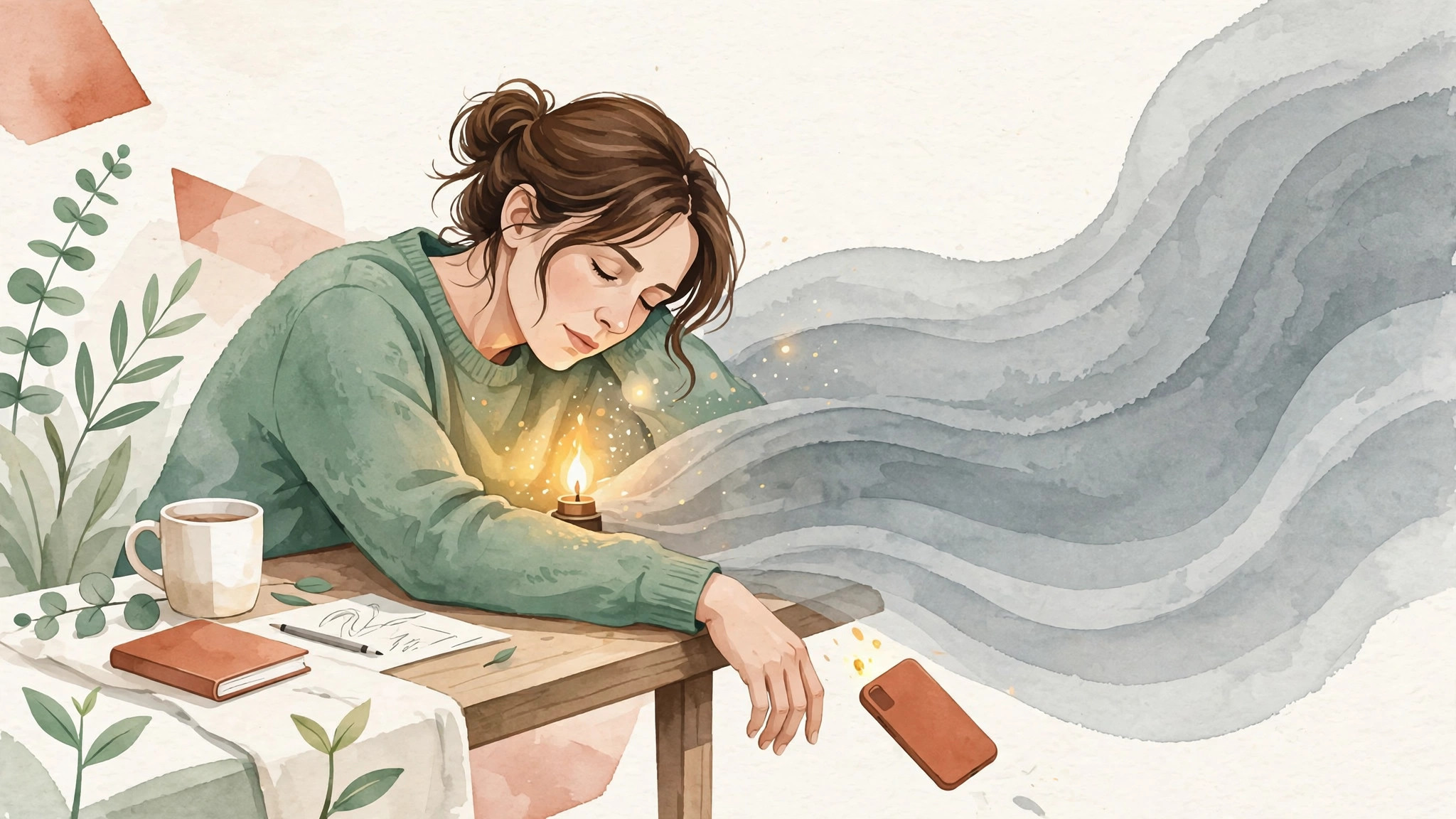
It was 11:47 on a Tuesday night when I caught my own reflection in the black phone screen and barely recognized the woman staring back. My eyes were dry and burning. My neck had that stiff, locked feeling. My phone battery was at 4%.
I had sat down on the couch at 9:30. "Just five minutes," I'd told myself, the way you tell yourself things you don't believe even as you say them. Then came the cooking videos, the apartment tours, someone's dog learning to talk with buttons, a thread about a celebrity divorce I have zero personal stake in.
Two hours. I chose every single video. And I could not remember a single one.
Here's the part that scared me: I didn't feel tired. I felt hollow. Like someone had opened a valve somewhere inside me and let all the air out. The apartment was quiet. My tea had gone cold two hours ago. And I sat there thinking, with genuine confusion: I did nothing. Why do I feel worse than if I'd run a marathon?
If that feeling is familiar to you, I want to tell you its name. It's a dopamine crash. And understanding it changed everything about how I handle my evenings.
What a dopamine crash actually is
Let me explain it the way my psychiatrist explained it to me, because the textbook version made my eyes glaze over.
Your brain runs on a chemical called dopamine, and despite what the internet says, dopamine isn't really the "pleasure chemical." It's the anticipation chemical — the thing that makes you get up and do stuff.
When you do something highly stimulating — doomscrolling, a four-hour hyperfocus sprint, an intense night out with friends, even a really gripping video game session — your brain floods with dopamine. It feels amazing. That's the whole point.
But here's the catch nobody tells you: after the flood comes the trough. When the stimulation stops, your dopamine doesn't gently return to normal. It drops below your baseline. For a while, your brain has less motivation-chemical than it had before you started.
That's the crash. It's not a metaphor. It's a neurochemical dip, and for ADHD brains — which already run on a thinner dopamine supply than most — the dip hits harder and feels deeper.
The first time I understood this, I was sitting in my psychiatrist's office nearly in tears because I'd spent a whole Saturday "relaxing" on my phone and ended up feeling like a wrung-out dishrag. She said, "Rachel, you didn't rest. You ran a marathon on your reward system and then wondered why you couldn't walk."
I think about that sentence at least once a week.
How it's different from plain tiredness
This distinction matters, because I spent years treating my crashes like tiredness and making them worse.
Tiredness is a body thing. Your muscles are heavy, your eyelids droop, and — this is the key — rest fixes it. You sleep, you nap, you sit quietly, and you feel better.
A crash doesn't work like that. Rest doesn't fix it. In fact, lying still during a crash often makes it worse, because now you're alone with the flat gray feeling and nothing to distract you from it. You lie on the couch feeling empty, and the only thing that sounds appealing is more stimulation — more scrolling, more sugar, picking a fight about nothing, refreshing the same three apps in rotation.
Here's my personal checklist for telling them apart:
- Tiredness wants a blanket. A crash wants your phone.
- Tiredness feels heavy. A crash feels hollow.
- Tiredness is cured by sleep. A crash can survive a full night's sleep and greet you at breakfast.
- Tiredness doesn't make you irritable about the way someone chews. A crash absolutely does.
The cruelest part? A crash often looks like laziness from the outside, and it feels like a character flaw from the inside. It's neither. It's chemistry. And chemistry can be worked with.
My two crash flavors
I've learned that I have two distinct kinds of crashes, and they need slightly different handling. See if you recognize yours.
The scroll crash. This is the Tuesday-night one. Hours of passive intake — social media, short videos, news spirals. Symptoms: eye strain, a weird buzzy feeling behind my forehead, irritability, and the infamous "I can't remember anything I just consumed." The scroll crash leaves me feeling both wired and exhausted, which is a combination I wouldn't wish on anyone.
The hyperfocus crash. This one is sneakier because it disguises itself as productivity. Last month I wrote for six straight hours — didn't eat, didn't drink water, forgot I had a body. When I finally stood up, the room tilted. I couldn't form a complete sentence. I burned toast and cried over it. Actual tears, over toast. My brain had spent its entire dopamine budget in one glorious sprint, and there was nothing left for the mundane business of being a person.
There's also a third one I've started noticing: the social crash. I genuinely love my friends. I had a wonderful time at my friend Priya's birthday dinner — laughed until my face hurt. Then I sat in my car in the driveway for twenty minutes, unable to make myself go inside.
The warning signs (catch it early)
Crashes are much easier to soften if you catch them on the way down instead of at the bottom. These are my personal early-warning signals:
- The jaw thing. I clench my jaw when I'm overstimulated. By the time I notice it, I've usually been scrolling for forty-five minutes.
- The sighing. Big, theatrical sighs that I don't consciously choose. My body knows before I do.
- The "one more" loop. One more video. One more chapter. One more round. When I hear that phrase in my head, the crash is already loading.
- Re-consuming. Rewatching a reel I've already seen. Rereading the same paragraph. My brain is too depleted to process anything new, so it loops.
- Shoulders by my ears. Tension migrates upward. If someone offered me a massage at that moment, I'd probably weep.
I started keeping a note on my phone — just a running list titled "crash clues" — and it took about three weeks before I could reliably spot one coming. Now I catch maybe half of them early. That's a genuine improvement, and I'll take it.
The gentle recovery protocol
Okay. You're crashed. You're hollow, irritable, reaching for your phone like it's oxygen. Here's what actually helps — not in theory, but in my lived, repeatedly-tested experience. This is my crash recovery protocol, refined over about two years of crashing roughly twice a week. (Yes, still. I'm better at recovering, not immune.)
1. Phone goes in another room. Not face-down. Not on silent. Another room. Mine sleeps in the kitchen during recovery. The crashed brain will bargain — "I just need to check one thing" — and the crashed brain is a liar. Distance is the only negotiation that works.
2. Cold water on your face and wrists. Thirty seconds. It sounds too simple to matter, and I resisted it for months because of that. It triggers something called the dive reflex — slows your heart rate, tells your nervous system the emergency is over.
3. One tiny physical thing. Not a workout — the crashed brain hears "workout" and files a formal protest. I mean: walk to the mailbox. Stretch your arms over your head. Make tea. Movement produces dopamine the slow, sustainable way, and even ninety seconds of it starts to turn the ship.
4. Eat protein, not sugar. The crash screams for sugar — quick dopamine, right now. And it works, for about twenty minutes, and then you're lower than before. I've learned to keep emergency protein within arm's reach: a handful of nuts, cheese, a boiled egg, Greek yogurt. It doesn't feel as good going down. It feels much better an hour later.
5. Get light on your face. Five minutes outside is ideal. A bright window works. Light is one of the most underrated dopamine regulators we have, and most of us crash in dim rooms staring at glowing rectangles, which is basically the worst possible lighting strategy.
6. Complete one small thing. Make the bed. Wash one dish. Reply to one text. Put one thing away. A finished task — any finished task — sends your brain the message that the world still works and you're still capable in it. I call these "proof-of-life tasks."
7. No big decisions for two hours. This is the rule I break most often and regret most consistently. The crashed brain is a catastrophizer. It will tell you to quit your job, end the friendship, throw out everything you own and move to Portugal. Write the thought down if you must. Revisit it tomorrow. It is almost never as urgent as it feels at 11:47 PM.
Honest disclosure: this protocol works for me maybe seventy percent of the time. The other thirty percent, I do everything wrong and scroll until 1 AM. And sometimes — this is also valid — the protocol is just going to bed at 8 PM like a Victorian child.
The hope part
Here's what I want you to know, sitting in your own version of my Tuesday night: the crashes get shorter. Not rarer, necessarily — I still crash. But shorter, and less scary, because now I know what they are.
I keep a "crash kit" list on my fridge now. It's embarrassingly simple: water, protein, light, one small thing, phone stays in kitchen. Simple gets used; elaborate gets admired and ignored.
You're not lazy. You're not broken. You're not "bad at relaxing." You have a brain that runs hot and crashes hard, and now you have a name for it and a way back up. That's not nothing. That's actually quite a lot.
Just so you know — this is my personal experience living with ADHD, not medical advice. If the flat, empty feeling sticks around for weeks rather than hours, that's worth bringing to a doctor, because that can be depression, which is a different thing entirely.
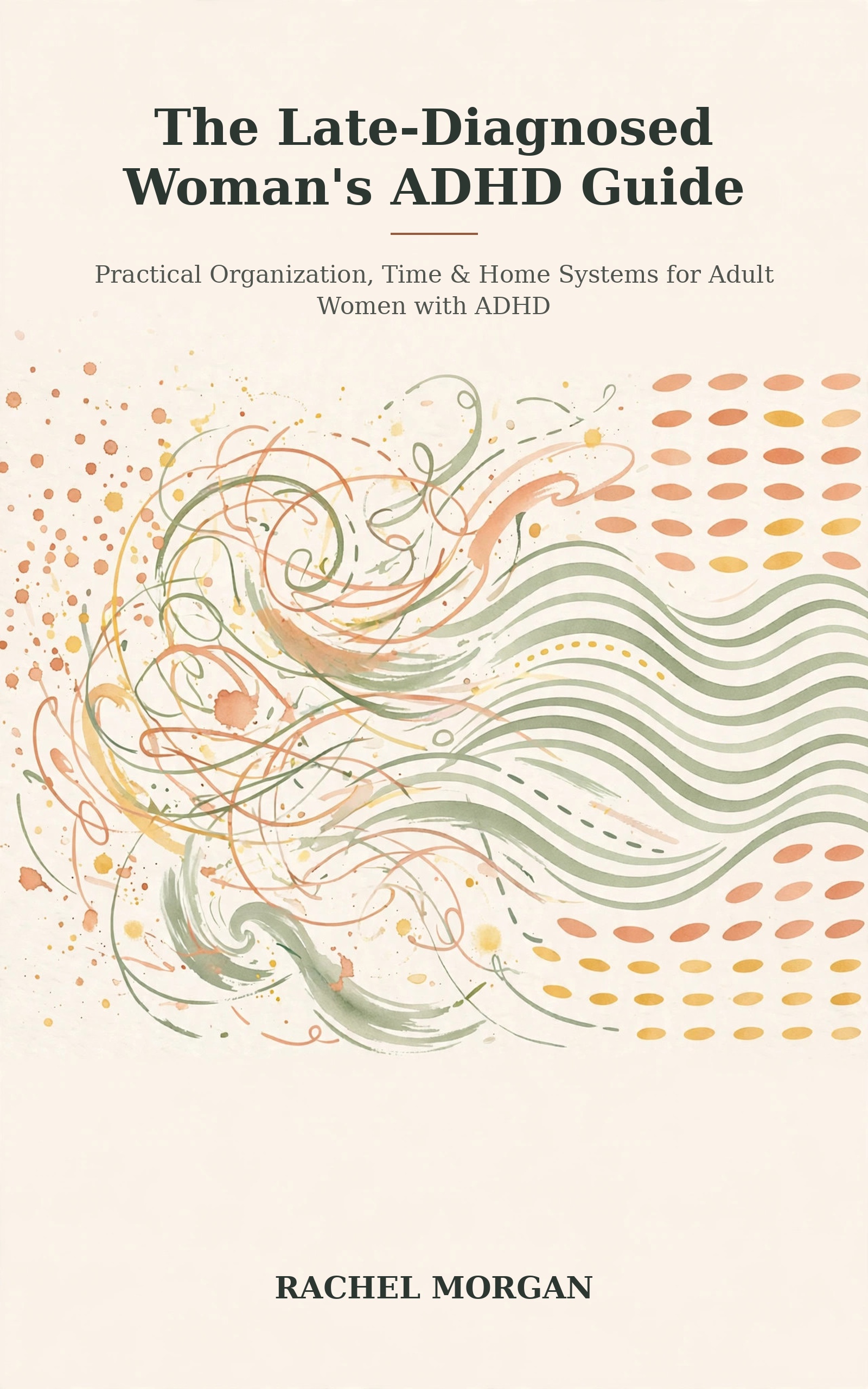
Want the full system?
My book The Late-Diagnosed Woman's ADHD Guide has 20 chapters of practical systems, 14 worksheets, and a 30-day reset plan — written by someone who lives this.
Get the book on Amazon Download Chapter 1 freeFAQs
Is a dopamine crash the same as burnout?
No, though they can feel similar and they sometimes travel together. A crash is acute — it hits over hours, usually right after intense stimulation, and it lifts within a day. Burnout is chronic — it builds over weeks or months of sustained overload and doesn't lift with one good night's sleep. Think of a crash as a wave and burnout as the tide. If you're crashing constantly, though, it's worth asking whether the crashes are symptoms of a bigger burnout pattern underneath.
How long does a dopamine crash usually last?
For me, most crashes last between two and six hours, and sleep almost always resets them — I rarely wake up still crashed. If the hollow, flat feeling persists for days or weeks despite rest, that's no longer a crash in my experience; that's the territory of depression or burnout, and it deserves professional support rather than a recovery protocol. The timeline is actually one of the best diagnostic clues you have.
Can you actually prevent a dopamine crash?
Partially, yes — and this is where a dopamine menu earns its keep. Scheduled breaks during hyperfocus (I use a vibrating timer because audible ones get ignored), time-boxing scroll sessions, and alternating high-stimulation activities with low-stimulation ones all reduce the severity. But I'll be honest: with an ADHD brain, I don't think you can prevent them entirely. The goal isn't zero crashes. It's shorter crashes, earlier detection, and faster recovery.
Why do I crave my phone even MORE during a crash?
Because your brain is trying to fix the deficit the fastest way it knows how. Your dopamine dropped, your brain remembers that the phone delivers quick hits, so it screams for the phone. It's logical from the brain's perspective — and completely counterproductive, because passive scrolling is what dug the hole. That's exactly why the first step of my protocol is physical distance from the phone, not willpower. You can't out-argue a neurochemical craving in the moment; you can only remove the object.

Rachel Morgan was diagnosed with ADHD at 34, after decades of wondering why everything felt harder for her. She writes practical, shame-free systems for women whose brains work differently — from the book The Late-Diagnosed Woman's ADHD Guide.
This site shares personal experiences and general information, not medical advice. Please consult a qualified professional for diagnosis or treatment.